AI Won't Fix Your GTM: How to Find and Fix Hidden Revenue Leaks
I joined Keith Newman on Liftoff with Keith to talk about why businesses should look for hidden revenue leaks before rushing to implement AI.
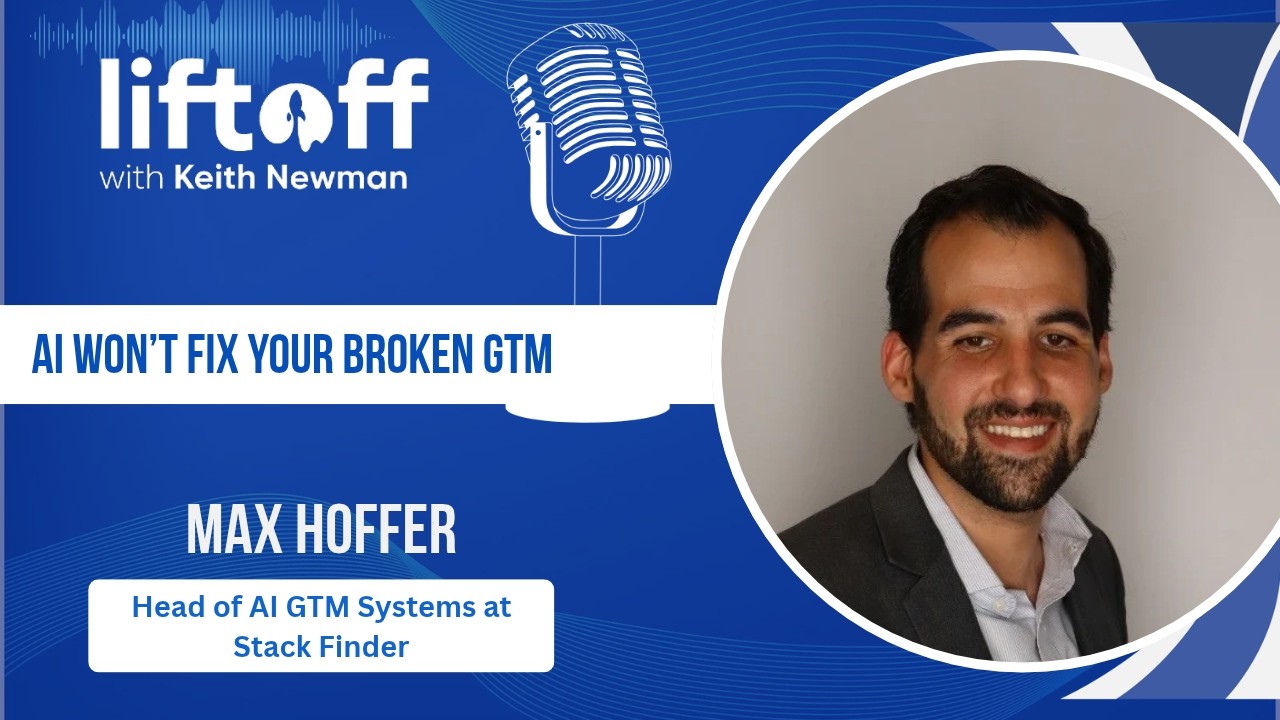
Liftoff with Keith is Keith Newman's interview show with top movers and shakers. Mark Cuban, Ron Conway, Guy Kawasaki, Ann Winblad, Mitch Kapor, Henry Schuck, Charles Lee, Nolan Bushnell, Trip Hawkins, Gary Kusin, Heidi Roizen, and more tech icons have all been on the show, so I was glad to join that lineup. The numbered takeaways below are from Keith's own write-up of our conversation, and I've added my own notes under each one.
Many businesses, particularly those trying to scale, have a solid offering but struggle to build a repeatable go-to-market (GTM) engine. Leads come in, sales conversations happen, and teams stay busy. Yet opportunities still slip through the cracks.
Now, AI promises to make these processes faster and more efficient. But there’s a problem: if your underlying processes are broken, AI may simply help you make the same mistakes faster.
In the latest episode of Liftoff with Keith, Max Hoffer, founder of Stack Finder and Head of AI Go-to-Market Systems, explains why businesses should look for hidden revenue leaks before rushing to implement AI.
Here are some of the key takeaways from our conversation.
1. Your revenue problem may be hiding in your processes
When revenue growth slows, it’s tempting to assume the business needs more leads, a bigger sales team, or another marketing campaign.
But the problem may be much closer to home.
A lead submits a contact form but receives no timely response. Marketing passes an opportunity to sales, but nobody follows up. Customer data sits across disconnected tools. Different teams work with different information, making it difficult to understand what is actually driving revenue.
Individually, these issues may seem minor. Together, they can create significant revenue leakage.
Before investing in more acquisition, businesses need to understand what happens to the opportunities they already have.
My take: When I look at a business, the first leaks I find are almost never exotic. A contact form routes to an inbox nobody checks. A demo request waits two days for a reply. The same customer shows up three times in the CRM under slightly different names. Each one is a small revenue leak, and together they become GTM debt that compounds every quarter you don't pay it down.
2. AI amplifies what is already there
AI can help automate repetitive tasks, process information, and improve operational efficiency. But it still depends on the quality of the systems and processes around it.
If your CRM contains incomplete or outdated information, automation can act on unreliable data. If lead ownership is unclear, automated workflows may not resolve the confusion. If your marketing and sales teams aren’t aligned, AI won’t automatically create that alignment.
This is why AI readiness involves more than selecting the right tools.
Businesses need to examine their data architecture, CRM integrity, system integrations, employee adoption, and cross-team processes.
The question isn’t simply, “Where can we use AI?”
It’s also, “Do we have a reliable process for AI to improve?”
My take: This is why I tell teams to fix the process before they buy the tool. AI readiness lives in your data and your workflows, not in the software you just signed a contract for. If your tools don't talk to each other, start by connecting your data so AI has one reliable picture to work from.
3. Start by examining the buyer journey
One practical approach Max discusses is to audit the customer journey from the first interaction through conversion.
Start with your website and contact forms. What happens when someone expresses interest? Who receives the notification? How quickly does someone respond? Is the lead routed correctly? Can you track what happens next?
Then look at the last ten inbound leads.
Were they contacted promptly? Were the next steps clear? Did anyone follow up? Can you determine why each opportunity progressed or stalled?
This small exercise can reveal gaps that are difficult to spot when looking only at high-level dashboards.
Rather than immediately adding new software, identify where the process breaks down and fix the underlying issue.
My take: This is exactly why I built the revenue agent. It scans your home page and your top high-intent pages the way a buyer would, then sorts the cracks it finds by department, so marketing, sales, and customer success each know what's theirs to fix. It's the fastest way I know to see your buyer journey from the outside in.
4. Work backward from closed deals
Understanding how revenue is generated is just as important as identifying where opportunities are lost.
Start with closed-won customers and work backward through the funnel. Examine the interactions, channels, qualification steps, and handoffs that contributed to those outcomes.
This helps businesses develop a clearer understanding of their actual sales process instead of relying entirely on assumptions or incomplete attribution data.
Once the process is understood, it’s easier to identify where automation could help, which tasks require human judgment, and what success should look like.
My take: Attribution reports tell you what got credit. Closed-won deals tell you what actually happened. When I work backward from real customers, the path almost always looks different from what the dashboard says. If you want a structured way to do this, the Revenue Bottleneck & Leak Audit walks you through where your systems are breaking.
5. Don’t automate everything at once
AI implementation doesn’t have to begin with a major transformation project.
A more practical approach is to choose one workflow with a clear problem and a measurable outcome.
For example, a business might focus on reducing the time it takes to respond to inbound leads, improving lead qualification, or reducing the manual effort involved in routine administrative work.
Before implementing a solution, establish a baseline. Measure the current process, define the expected improvement, and evaluate the results after implementation.
Useful metrics might include speed-to-lead, qualification rates, time saved, customer acquisition cost, and the amount of time employees can redirect toward higher-value work.
The goal isn’t to use AI everywhere. It’s to make meaningful improvements where they matter.
My take: Pick one workflow, write down how it performs today, and only then automate it. Speed-to-lead and customer acquisition cost are good places to start because everyone already agrees they matter. And when you do need a tool for that one workflow, find the right fit for your stack instead of buying the platform with the loudest demo.
6. Keep customer conversations at the center
As businesses adopt more automation, it’s easy to become overly focused on dashboards, tools, and operational efficiency.
But customer feedback remains essential.
Sales calls, customer conversations, and qualitative feedback can help businesses understand objections, refine their messaging, identify product gaps, and make better decisions about their roadmaps.
Technology can help teams process information more efficiently, but the insights still need to inform real business decisions.
And when presenting recommendations internally, clarity matters. Lead with the data, explain the result, and make a specific recommendation. This makes it easier for teams to understand the problem and decide what to do next.
My take: AI won't replace the human side of selling. Your human edge is your advantage. The best signal I get still comes from sitting in on sales calls and hearing the objections in the customer's own words. Use AI to process those conversations faster, not to stop having them.
The bigger lesson: Fix the process before adding the technology
AI creates real opportunities to improve how businesses operate. But successful implementation begins with understanding the business itself.
If your GTM process is fragmented, your data is unreliable, or your teams aren’t aligned, adding another tool may only introduce more complexity.
Start by identifying the bottlenecks. Understand where opportunities are getting lost. Fix the basics, choose a focused use case, and measure the impact.
A better revenue engine doesn’t begin with more automation. It begins with a clearer understanding of what’s broken and what needs to improve.
My take: Most of the teams I talk to don't have an AI problem. They have a process problem that AI would make louder. Fix the leaks first, cut the software you're paying for but not using with a Hidden Tax Audit, and then put AI to work on a GTM engine that's actually ready for it.
Fix the GTM engine before you add AI
A 90-day GTM strategy engagement to find the leaks and rebuild the process.
See the GTM Strategy engagementWatch: Max Hoffer on Liftoff with Keith
The full episode plays right here.
Also listen on Spotify · Apple Podcasts
Originally published by Keith Newman · Liftoff with Keith.
Clips from the episode
Share this issue