Revenue Leakage Is a Data Problem First, and It Costs the Most at Fundraising Time
Every leak is detectable today, with data you already pay to collect. They go undetected because the systems holding the evidence were never connected.
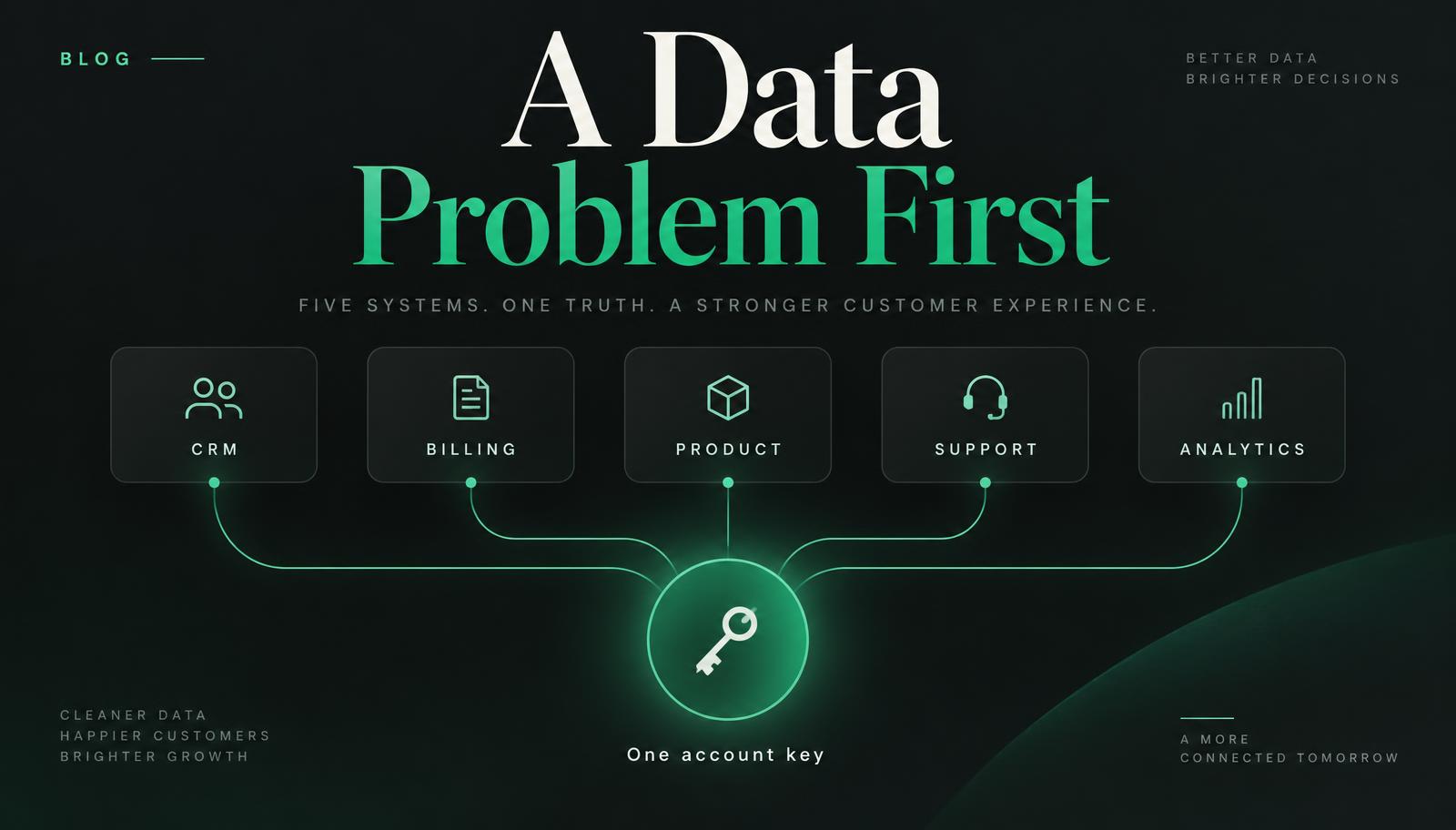
Here's the uncomfortable part. Every revenue leak is detectable. Most are detectable today, with data you already pay to collect. They go undetected because the systems that hold the evidence were never connected to each other.
This playbook covers why leakage projects stall, the three things you need to start, and the two costs of waiting, including the one that shows up when someone audits your numbers.
Why leakage projects stall
Your CRM knows what was sold. Your billing system knows what was invoiced. Your product knows what was used. Your support desk knows how it's going. Your analytics knows how they arrived. Five systems, five customer IDs, five definitions of "active," and no shared key.
That's the real blocker, and it's why most leakage projects stall. Teams jump to a tool when the missing piece is the connections: a shared identity and a shared vocabulary that let those five systems be read as one story about one account.
The three things you need to start
You don't need a data warehouse rebuild to start. You need three things:
- One account key. A single ID that resolves across CRM, billing, product, and support. Imperfect and mapped beats perfect and theoretical.
- Agreed definitions. What counts as active, as churned, as expansion, as contracted revenue. Written down, in one place, with one owner.
- A snapshot cadence. Weekly or monthly point-in-time captures, so you can see drift instead of only the current state. Drift is the signal; the current state is just a number.
With those three, most leakage detection becomes a reporting exercise rather than an engineering program. If you're not sure which of your tools can share data natively, check what connects in Connect Your Data before you buy anything new.
What it costs at scale
There are two costs, and the second is usually larger.
The operating cost is the leak itself, compounding. A single point of unbilled usage on recurring revenue isn't a one-time miss. It's a permanent cut to the base that every future increase is calculated from.
Here's simple math to show it. These numbers are made up. Say an account should be billed $100,000 a year but is billed $99,000. That's $1,000 missed this year. Next year you apply a 5 percent increase to $99,000 instead of $100,000, so the gap grows to $1,050, and it keeps growing every year after. Multiply that by every account with the same drift.
What it costs at fundraising time
The diligence cost shows up when someone outside the company audits your numbers. Buyers and investors don't just look at growth. They look at revenue quality: whether contracted revenue reconciles to billed revenue, whether net revenue retention is calculated the same way period over period, and whether churn definitions have quietly changed.
Inconsistency here doesn't just cost a multiple point. It drags diligence out, invites a working-capital adjustment, and moves the negotiation onto the buyer's terms.
Your next step
Start with the account key this month. Map one ID across your CRM, billing, and product for a single segment, then write down your definitions. If you haven't sized your leaks yet, start with where revenue leaks across your business.
Rather not map it yourself?
The 90-day GTM Strategy gives your team a full revamp plan for your GTM engine: lead acquisition, the right channels to go after, product marketing, and the right ICP. It goes past SEO rules of thumb and looks at every revenue leak across your GTM.
Get my 90-day GTM planShare this issue