Where Revenue Leaks Across Your Business, and Where It Sits by Company Size
Revenue doesn't leak in one place. It leaks at the seams between systems, and where the biggest seam sits depends on how big you are.
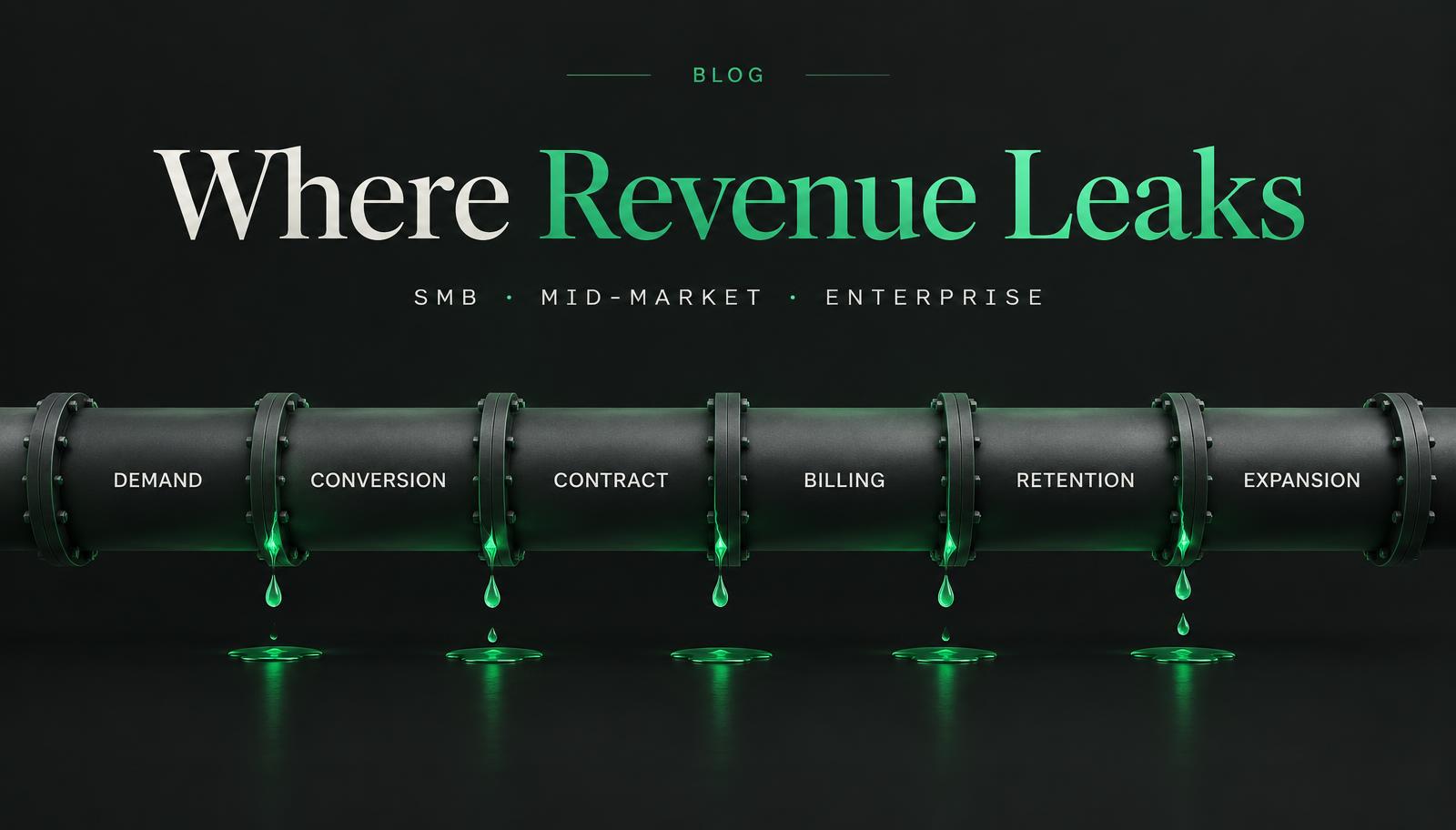
Most teams go looking for revenue leakage in one place: the funnel, the pipeline, or the churn report. The money doesn't leak in one place. It leaks end to end, at the seams where one system hands off to the next and nobody owns the handoff.
This playbook does three things. It gives you a map of the seams, ranks the eight leaks I see most often, and shows where the leak sits for your company size, with the first fix that pays for the rest.
Step 1: Map your seams
Every layer of revenue has a question nobody owns. Start here.
| Layer | Typical question nobody owns | Where the answer lives |
|---|---|---|
| Demand | Which intent arrives and never gets recognized? | Analytics, session data, CRM |
| Conversion | Which page or form is quietly failing? | Site, forms, CRO tooling |
| Contract | What did we actually promise this account? | CRM, CPQ, signed docs |
| Billing | Does the invoice match the contract and the usage? | Billing, ERP, product telemetry |
| Retention | Which accounts are decaying before they churn? | Product usage, support, CS notes |
| Expansion | Who has outgrown their plan and never been told? | Product usage, billing |
Step 2: Check the eight places leaks hide
Ranked roughly by how often I see them and how cheap they are to close. Start at the top and work down.
- Intent that arrives and is never recognized. Anonymous traffic with clear buying signals (pricing page, comparison page, docs) leaves without a path that matches where it is in the decision. Nothing breaks. The visitor simply leaves.
- Forms and flows that fail silently. A required field that rejects a valid input. A confirmation that never sends. A calendar that opens a redirect chain. These don't throw errors on a dashboard; they throw the visitor away.
- Answers the page doesn't give. Buyers arrive with a question and leave without an answer, because the page was written to describe the product rather than to answer the question. More and more, this also decides whether an AI assistant can quote you at all.
- Discount and terms drift. What sales agreed to, what the contract says, and what billing charges start to diverge. Each divergence is small. The total isn't.
- Unbilled usage and entitlement drift. In usage or seat-based models, the gap between what the customer consumes and what the invoice reflects widens quietly with every plan change and mid-term amendment.
- Renewal autopilot. Renewals process at the old rate, with the old terms, on the old plan, because no one reviewed them. Uplifts that were available in the contract are never taken.
- Silent decay before churn. Usage falls for a quarter, support tickets change tone, the champion goes quiet.
- Expansion signals nobody reads. An account has doubled its usage and is still on the plan it bought two years ago. That isn't a pricing problem. It's a detection problem.
The first three live on your website, which is why I built the revenue agent to scan for them by department. The rest live behind the sale, in the handoffs between sales, finance, and CS.
Step 3: Find where the leak sits for your size
Leakage is universal; its center of gravity isn't. An SMB and an enterprise both lose revenue end to end, but they lose it in different places, for different structural reasons, and the first fix that pays for the rest is different in each case. I use annual recurring revenue bands here.
| SMB (under $5M) | Mid-market ($5M–$50M) | Enterprise ($50M+) | |
|---|---|---|---|
| Dominant leak | Demand arrives and is never captured | The quote-to-cash seam | Contract and entitlement drift |
| Typical stack | 3–6 tools, no warehouse | 10–20 tools, first RevOps hire | 30+ systems plus a warehouse |
| Who owns leakage | Nobody. It's everyone's ninth priority | RevOps, part-time, without authority | Several teams, no shared join |
| What it costs | Mostly opportunity cost: demand paid for and not converted | Both halves at once, and the seam between them widens fastest here | Mostly realized cost: revenue contracted and never collected |
| Cheapest first fix | Walk your own primary conversion path on a real phone | Build the account key and reconcile one segment for one month | Reconcile contract to invoice on the top 50 accounts by value |
SMB (under $5M)
At this size almost all the recoverable money is pre-sale. You don't have enough contracts for contract drift to matter, and you don't have the tooling complexity that creates billing errors. What you have is a website doing the work of a sales team, and nobody watching it closely.
The three that dominate: high-intent visits that arrive with no path matching where the buyer is; a conversion path with a quiet failure in it that nobody has walked in months; and follow-up that arrives hours or days after the enquiry, long after the buyer has moved on.
Retention still matters. The typical small-contract business is shrinking its existing base slightly and covering it with new sales. But the leverage is upstream. Doubling the yield of demand you already pay for beats an entitlement audit on 40 accounts.
First fix: complete your own primary conversion path on a mid-range phone, then check that every enquiry gets a human response inside an hour. Days of work, not quarters.
Scaling note: the habits you skip here become the debt you inherit next. Every unmapped tool, every undefined metric, and every manual handoff you tolerate under $5M is a data problem waiting for you at $10M.
Mid-market ($5M–$50M)
This is where both halves leak at once and the seam between them widens fastest. You have enough contracts for drift to matter, enough tools for the data to fragment, and usually one RevOps person holding it together without the authority to change how any team works.
The three that dominate: the quote-to-cash seam, where what sales agreed, what the contract says, and what billing charges have started to diverge; unbilled usage and entitlement drift as plan changes and mid-term amendments pile up; and renewals processing at old terms because no one reviews usage against plan before they auto-renew.
Retention here usually reads healthier, which is exactly what makes it dangerous. A net retention number above 100 percent can hide a gross retention problem that's being papered over by expansion in a handful of accounts.
First fix: pick one account key, build the mapping table across CRM, billing, and product, and reconcile one segment for one month, contract to invoice. That single exercise surfaces both the dollars and the data problems.
Scaling note: what breaks on the way to enterprise is definitions. As soon as two teams calculate retention two ways, you lose the ability to tell whether anything you did worked.
Enterprise ($50M+)
Here the money is post-sale and it's realized, not theoretical. Bigger contracts tend to buy better retention, but they also buy complexity: bespoke terms, negotiated discounts, custom entitlements, multi-system provisioning, and a contract that touches six systems between signature and invoice.
The three that dominate: contract and entitlement drift at scale, where each variance is small and the total isn't; discount and terms drift, where what was negotiated never fully reaches billing; and detection lag, where the data to catch all of this already exists in a warehouse that nobody has pointed at the question.
Add the diligence angle. At this size, not being able to reconcile contracted revenue to billed revenue isn't just a cash problem. It's a valuation problem the first time an outside party audits the numbers.
First fix: reconcile contract to invoice for the top 50 accounts by value. It's a week of work and it typically pays for the entire program.
Scaling note: you almost certainly already have the data. What you don't have is one person whose job is to report a single leakage number across both halves.
Your next step
Pick the first fix for your size and do it this week. If you want a structured way to find the broken systems behind your leaks, take the Revenue Bottleneck & Leak Audit. When you're ready to fix them one by one, the revenue leakage playbook walks through each leak: symptom, cause, fix, and proof.
Rather not map it yourself?
The 90-day GTM Strategy gives your team a full revamp plan for your GTM engine: lead acquisition, the right channels to go after, product marketing, and the right ICP. It goes past SEO rules of thumb and looks at every revenue leak across your GTM.
Get my 90-day GTM planQuestions nobody owns
- Which intent arrives and never gets recognized?
- That's the demand layer. The answer lives across analytics, session data, and your CRM.
- Which page or form is quietly failing?
- That's the conversion layer. The answer lives in your site, your forms, and your CRO tooling.
- What did we actually promise this account?
- That's the contract layer. The answer lives across your CRM, CPQ, and signed documents.
- Does the invoice match the contract and the usage?
- That's the billing layer. The answer lives across billing, ERP, and product telemetry.
- Which accounts are decaying before they churn?
- That's the retention layer. The answer lives across product usage, support, and CS notes.
- Who has outgrown their plan and never been told?
- That's the expansion layer. The answer lives across product usage and billing.
Share this issue