The Revenue Leakage Playbook: Symptom, Cause, Fix, and Proof
A playbook, not a diagnosis. Ten leaks, each with what you'd observe, why it happens, the fix, and how you know it worked.
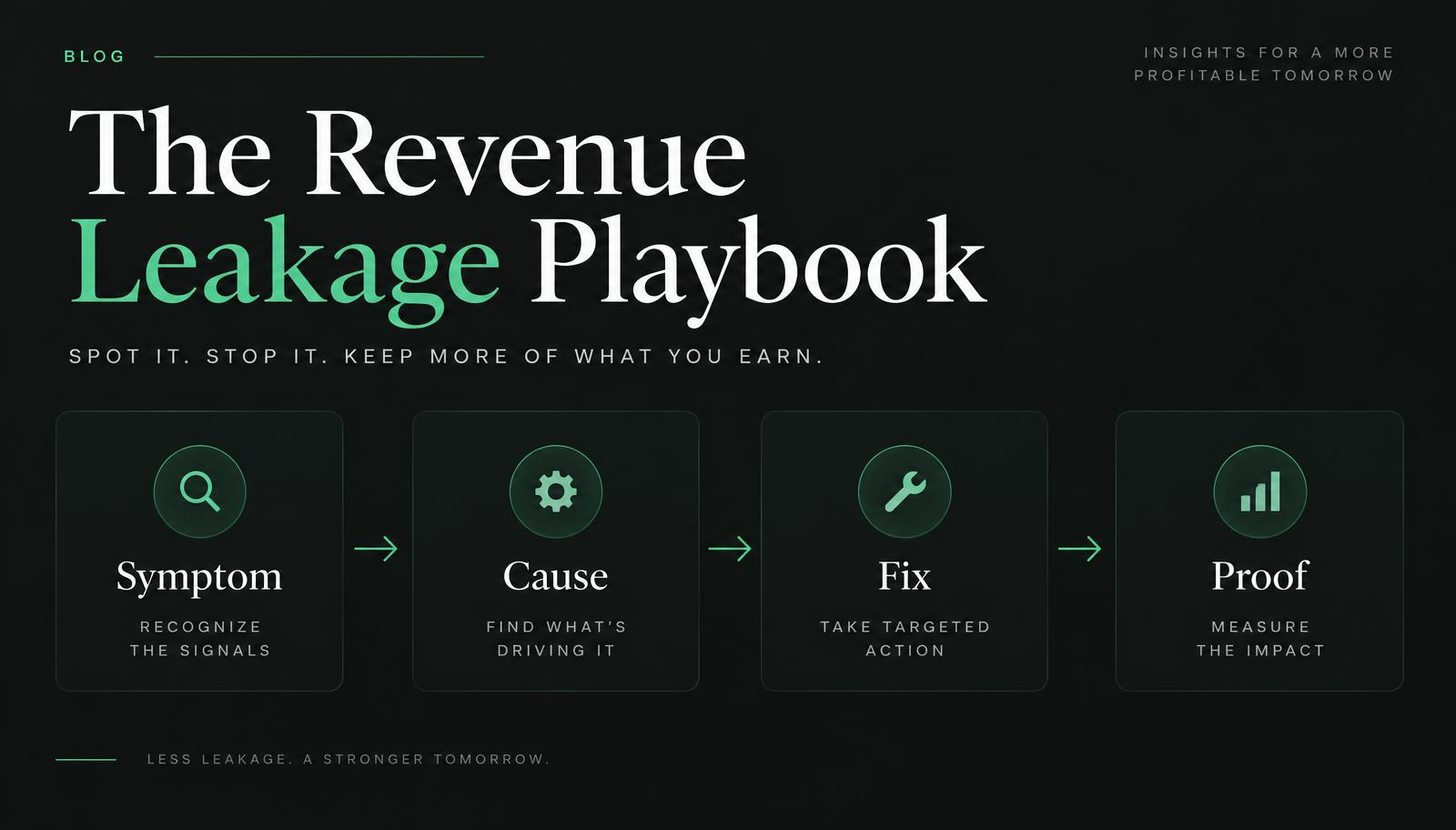
A playbook, not a diagnosis. Each leak below follows the same path: what you'll notice, why it happens, the fix, and how you know it worked. Some leaks matter far more at one company size than another, so each section starts with who feels it most. None of it requires hiring anyone, including me.
If you haven't mapped where your leaks sit yet, start with where revenue leaks across your business, then come back here and work the list.
What to watch for at your size
Small businesses. Your leaks are mostly at the front door. Start with #1 (intent nobody recognizes), #2 (conversion paths that fail quietly), and #10 (attribution that isn't real). They're cheap to fix and usually pay back inside a month.
Mid-market companies. You're leaking at both ends. On the way in, watch speed and answers: #4 (slow follow-up) and #3 (unanswered questions). Once customers are signed, watch terms and usage: #5 (discount drift) and #6 (unbilled usage).
Enterprises. Your biggest leaks are after the sale. Focus on #7 (renewals on autopilot), #9 (expansion signals nobody reads), and #8 (silent decay before churn), which hits every size but costs you the most.
1. Intent arrives and is never recognized
This one hurts small businesses and mid-market companies most, because a handful of high-intent visitors can be a big share of your pipeline. You'll see healthy traffic to your pricing, comparison, and docs pages while enquiries stay flat. Nothing breaks. The visitor simply leaves.
It happens because the page was built to describe the product to a general audience. Someone deep in their evaluation gets the same call to action as a first-time reader, and there's no next step that fits where they are.
The fix: find your three highest-intent pages by conversion rate, not by traffic. Give each one a next step that matches the stage, like a comparison, a specific answer, or a scoped call, instead of a generic contact form.
How you know it worked: conversion rate on those three pages over 30 days, compared to the 30 before.
2. A conversion path fails quietly
If you're a small team, this one probably costs you more than you think. No dashboard shows an error, yet your form or booking flow produces fewer records than your traffic suggests.
Nobody on the team is a visitor. Validation rules, redirect chains, and confirmation emails get tested once at launch and never again, so a broken step can sit there for months.
The fix: once a month, walk the full path on a mid-range phone as if you were an outsider, confirmation email included. Write down every step that surprises you.
How you know it worked: path completion rate by device, checked weekly.
The first two are what the revenue agent checks on your homepage and top high-intent pages, so you don't have to walk them by hand every time.
3. The page doesn't answer the question
Small businesses and mid-market companies feel this one in their sales calls. The same three questions open every call, because the website never answered them.
Product marketing writes descriptions; buyers ask questions. Nobody reconciles the two. More and more, that also means an AI assistant trying to quote you can't find an answer either.
The fix: take the top ten questions from recorded calls and answer each one in plain language on the page where it belongs, short enough to be quoted.
How you know it worked: fewer calls opening with those questions, with answer coverage reviewed every quarter.
4. Follow-up is slower than the buying window
This shows up most at small and mid-market companies, where one person often owns the inbox. Leads get worked, but very few enquiries turn into meetings.
Routing depends on someone checking an inbox, and enquiries arrive outside their hours. By the time anyone replies, the buyer has moved on.
The fix: route every enquiry to a named owner with a response-time commitment, and make sure there's an out-of-hours path at all. Your odds of qualifying a lead fall away fast once the first hour passes.
How you know it worked: median first-response time and enquiry-to-meeting rate, monthly.
5. Discount and terms drift
Once you reach mid-market or enterprise size, deals get negotiated, and this leak starts. You'll notice invoices that don't match what the account manager remembers agreeing to.
The agreement lives in three places: the conversation, the contract, and the billing setup. Only one is the source of truth, and it isn't always the same one.
The fix: make the contract the single source, and add a pre-invoice check on any account whose terms changed during the period.
How you know it worked: the gap between contracted and billed revenue, as a percentage of contracted revenue, monthly.
6. Unbilled usage and entitlement drift
Mid-market and enterprise companies with usage or seat-based pricing feel this most. Some accounts use more than their tier and are never invoiced for it. Others pay for things they never received.
Plan changes and mid-term amendments update one system and not the others, and nothing checks what was delivered against what was sold.
The fix: run a monthly usage-versus-entitlement report on every active account. Bill the overage, correct the shortfall, and log both.
How you know it worked: unbilled usage, in dollars, trending toward zero.
7. Renewals on autopilot
This is an enterprise and mid-market leak, because that's where contracts carry uplifts. Renewals go through cleanly at the old rate, on the old plan, with the old terms.
A clean renewal looks like success, so nobody inspects it. Contract uplifts are optional in practice, so they get skipped.
The fix: add a review 60 days before each renewal that compares usage to plan and checks whether an uplift applies. Make it a step in the renewal process, not a reminder.
How you know it worked: the share of renewals reviewed before processing, and the uplift value you actually collect each quarter.
8. Silent decay before churn
Every company size has this leak. Churn arrives as a surprise, and the post-mortem finds the warning signs were months old.
Usage trends, support tone, and champion activity live in three systems that nobody reads together, so the ninety days before a cancellation go unnoticed.
The fix: define three decay signals, compute them weekly, and require a logged intervention on any account that trips two of them.
How you know it worked: open decay flags without a logged intervention, weekly, and churn forecast accuracy, quarterly.
9. Expansion signals nobody reads
Mid-market and enterprise companies leave the most money here. An account has doubled its usage and is still on the plan it bought two years ago.
Expansion gets treated as a sales motion rather than a detection problem, so it only happens when a rep happens to look.
The fix: a weekly list of accounts using more than 80 percent of their tier, sent to an owner with a deadline.
How you know it worked: expansion revenue that came from detection rather than from customers asking.
10. Attribution that isn't real
Small businesses and mid-market companies get hurt most, because they're usually deciding where the next marketing dollar goes. You'll see a channel that "converts nothing" and a direct-traffic bucket that keeps growing.
Internal links carrying campaign tags overwrite the original source, so your system credits the conversion to your own site.
The fix: strip campaign tags from every internal link. It's the most common cause of a misread channel mix, and it's an afternoon of work.
How you know it worked: the share of conversions credited to direct or internal sources, monthly.
Your next step
Don't try to run all ten at once. Pick the two that matter most for your size, run them for 30 days, and check the number. If you want to know which of your systems are broken before you start, take the Revenue Bottleneck & Leak Audit.
Rather not map it yourself?
The 90-day GTM Strategy gives your team a full revamp plan for your GTM engine: lead acquisition, the right channels to go after, product marketing, and the right ICP. It goes past SEO rules of thumb and looks at every revenue leak across your GTM.
Get my 90-day GTM planShare this issue