Marketing Is Blamed for a Ratio It Doesn’t Control
The revenue that never shows up as churn, and why the team held responsible for CAC is rarely the team that controls what moves it.
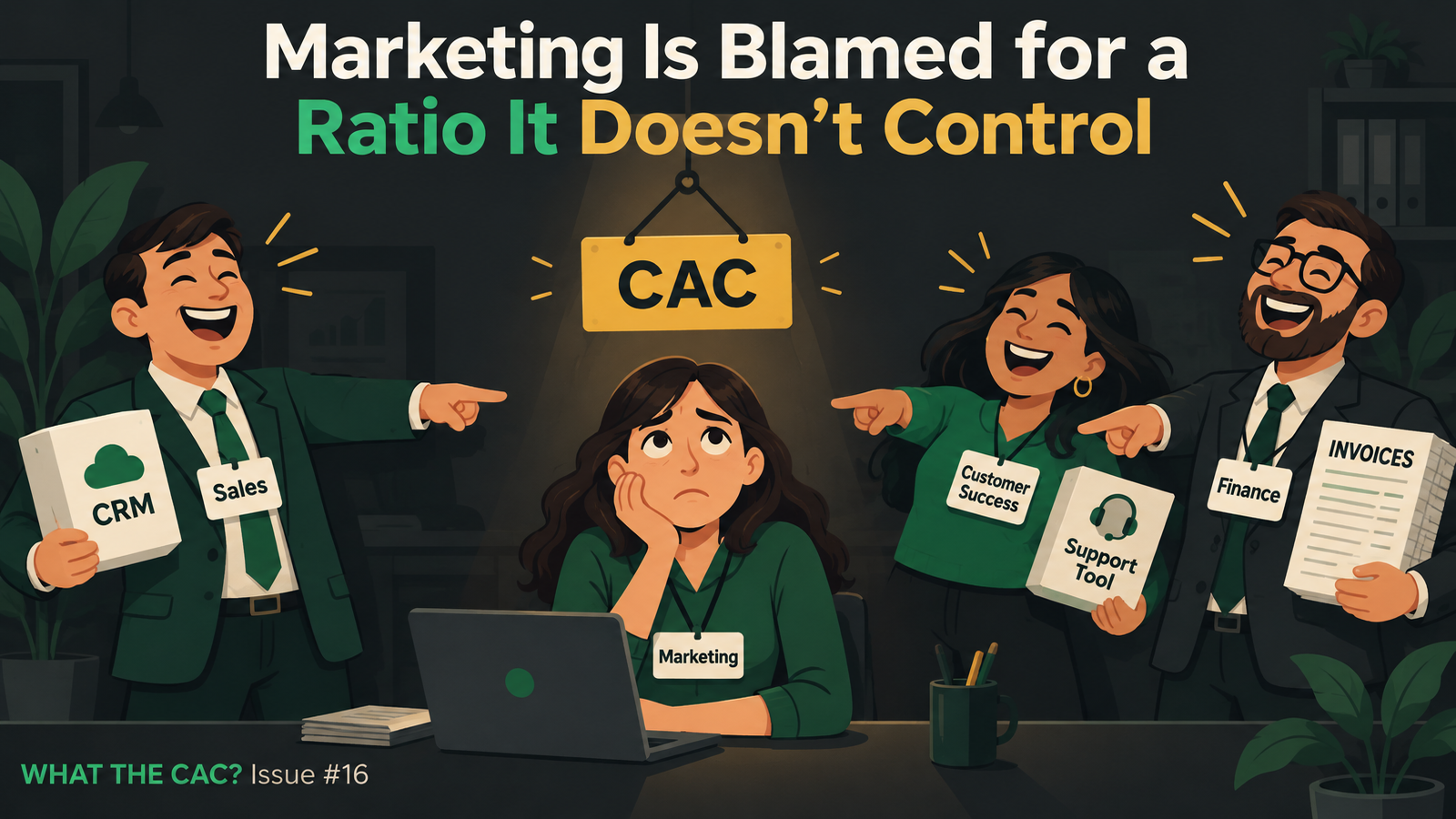
This week’s focus is on the revenue that never shows up as churn, and on why the team held responsible for CAC is rarely the team that controls what moves it.
I’ll cover what a dormant account really costs, how a price increase you agreed to and never collected shrinks lifetime value, and why clean contract-to-invoice data matters. Then I’ll cover how budget ownership turns CAC into a number one team answers for and three teams influence.
I’ve been the senior marketing hire handed a pipeline number to own more than once, so this one is personal.
What is a dormant account, and why is it worse than churn?
A dormant account is a customer who is still on the books but has stopped using the product or responding. Churn has a date, but a dormant account sits in the data counted as healthy, so it hides lost lifetime value until the renewal arrives.
Dormant accounts are easy to miss because nothing marks them. No cancellation comes in, the account stays in the CRM, and the renewal forecast keeps counting it. That is why I think of them as a scarier number than churn. A churned customer at least has a date attached to it.
They cost you in four ways. They inflate the renewal forecast, because accounts that won’t renew are still counted as healthy. They waste rep time, since people keep working accounts that never reply. They keep costing money, because CRM, enrichment, and seat fees continue for records that are effectively dead. And they hide the real churn signal until it is too late to act on it.
“A churned customer at least has a date on it. A dormant one just sits there looking healthy.”
You can size it with data you already have. Write down what dormant means for your business, count the accounts that match, and multiply by their average annual contract value. Compare that to your renewal forecast, and the gap shows how much of the forecast depends on accounts that have gone quiet.
For the LTV:CAC ratio, the issue is that lifetime value gets reported as if every counted customer is still contributing. Dormant accounts make LTV look higher than it is, which can make acquisition look more efficient than it really was.
Related: stackfinder.com/answers/dormant-accounts
How does an uncollected price uplift shrink lifetime value?
When a renewal goes through at the old rate and the increase you were entitled to is never applied or billed, every later renewal starts from a lower base. Lifetime value falls, and nothing in the report shows why.
A clean renewal at the old rate feels like a win in the meeting. In the numbers, it is a leak. The contract allowed an increase, someone agreed to it, and nobody on the team that manages the renewal knew it was there.
The loss compounds. If a yearly increase is missed once, every later year is billed from the lower number, and the gap widens with each cycle. A related leak shows up when an account doubles its usage but never moves to a larger plan. The customer is getting more value and you are collecting the same revenue.
These leaks hide for a simple reason. Contract terms live in documents, billing runs from its own system, and neither one reads the other. Each team sees its own part correctly, and nobody sees the difference.
“A clean renewal at the old rate looks like a win in the room. In the numbers, it’s a leak.”
This matters for CAC because lifetime value is the other half of the ratio. When uplifts go uncollected, LTV shrinks even though CAC hasn’t moved, and the LTV:CAC ratio slips away from the 3:1 floor. Small leaks matter more when the ratio is already close to that line.
Related: stackfinder.com/answers/contract-price-uplift | stackfinder.com/answers/ltv-cac-ratio
Can your team reconcile contract-to-invoice today?
Most teams can’t, because each system holds its own version of the customer. Reconciling takes one account key across the CRM, billing, product, and support, written definitions with one owner, and regular snapshots to catch drift.
The CRM, billing, product, and support systems each identify a customer differently and define “active” differently. So, the evidence of a leak already exists in your data, but nothing connects it. You don’t need a new tool or a data warehouse project to start. You need the systems to agree on who the customer is.
Three habits get you most of the way. Use one account key that appears in every system. Write down definitions, such as what active and dormant mean, and give each one an owner. And take regular snapshots so you can see drift as it happens, not a year later.
The cost often arrives all at once. When you raise money, investors ask whether contracted revenue reconciles to billed revenue. If your teams can’t answer, diligence stalls, and that is when the leaks become expensive. It also means the lifetime value in your ratio is only as reliable as the revenue data behind it.
What is fully loaded CAC?
Fully loaded CAC is the total cost of winning a customer, including ad spend, salaries, tools, agencies, and the sales effort that closes what Marketing generates, divided by the customers won.
It matters here because much of that cost sits outside the Marketing budget. A tool a sales manager buys to chase leads is part of the cost of acquiring customers, even though Marketing never approved it.
Related: stackfinder.com/answers/customer-acquisition-cost
Why is Marketing held responsible for CAC when three teams fund the fixes?
It usually isn’t fair, but it is common. CAC lands on Marketing because Marketing reports it, while the costs that move it are spread across teams that each control their own budget. Accountability for the number has to come with some control over what drives it.
Fully loaded CAC includes tools, data, the people who run them, and the sales effort behind each deal. Much of that sits outside Marketing’s budget. Software spend is increasingly controlled by individual business units instead of a central owner, so each team funds its own fix out of its own money.
Here is how that plays out. Marketing buys a tool for the handoff. Sales buys another for the same handoff. Customer Success adds a third to track the same accounts. The process between them still breaks because nobody owns it, and the combined cost lands in fully loaded CAC. When the number rises, Marketing is the team asked to explain it.
Finance has also taken a bigger role in technology spending, and Marketing is often the first place it looks, because its spend is large and can look opaque from the outside. A cut there costs more than the line item. You lose the people who understand how the revenue systems fit together.
“I’ve been the marketing hire handed a number to own more than once. Owning a number you can’t influence isn’t accountability. It’s blame.”
The same is true on the lifetime value side. Marketing doesn’t control renewals, uplifts, or whether accounts go dormant. If CAC is judged alone, Marketing answers for decisions that Customer Success, RevOps, and Finance make.
A fairer setup has three parts. The teams write down one shared problem the same way. One person owns the process that runs between them. And the fix gets one shared budget, so it is funded once instead of three times. Then CAC and LTV are reviewed together by all three teams, which is the only way a ratio that depends on everyone can be owned by anyone.
Related: stackfinder.com/answers/data-governance-framework
What should you do this week?
Three checks, each under an hour.
- Write a one-sentence definition of a dormant account for your business, count the accounts that match, and multiply by their average annual contract value.
- Pick your five largest customers and compare what each contract says you should bill with what billing actually invoiced, including any uplift.
- List every tool that touches the handoff between Marketing, Sales, and Customer Success, who pays for each one, and who owns the process between them.
All three test whether the number Marketing is held to is built from things Marketing can actually see and influence.
If you want a second set of eyes on where your CAC is leaking, or what your software stack really costs you, you can book a call at stackfinder.com/deep-dive.
Reply and tell me what you found.
Share this issue