Switching To A Cheaper AI Model Won't Lower Your CAC
Why a cheaper model won't lower what AI costs you, what owning it really includes, and what to benchmark before your next renewal.
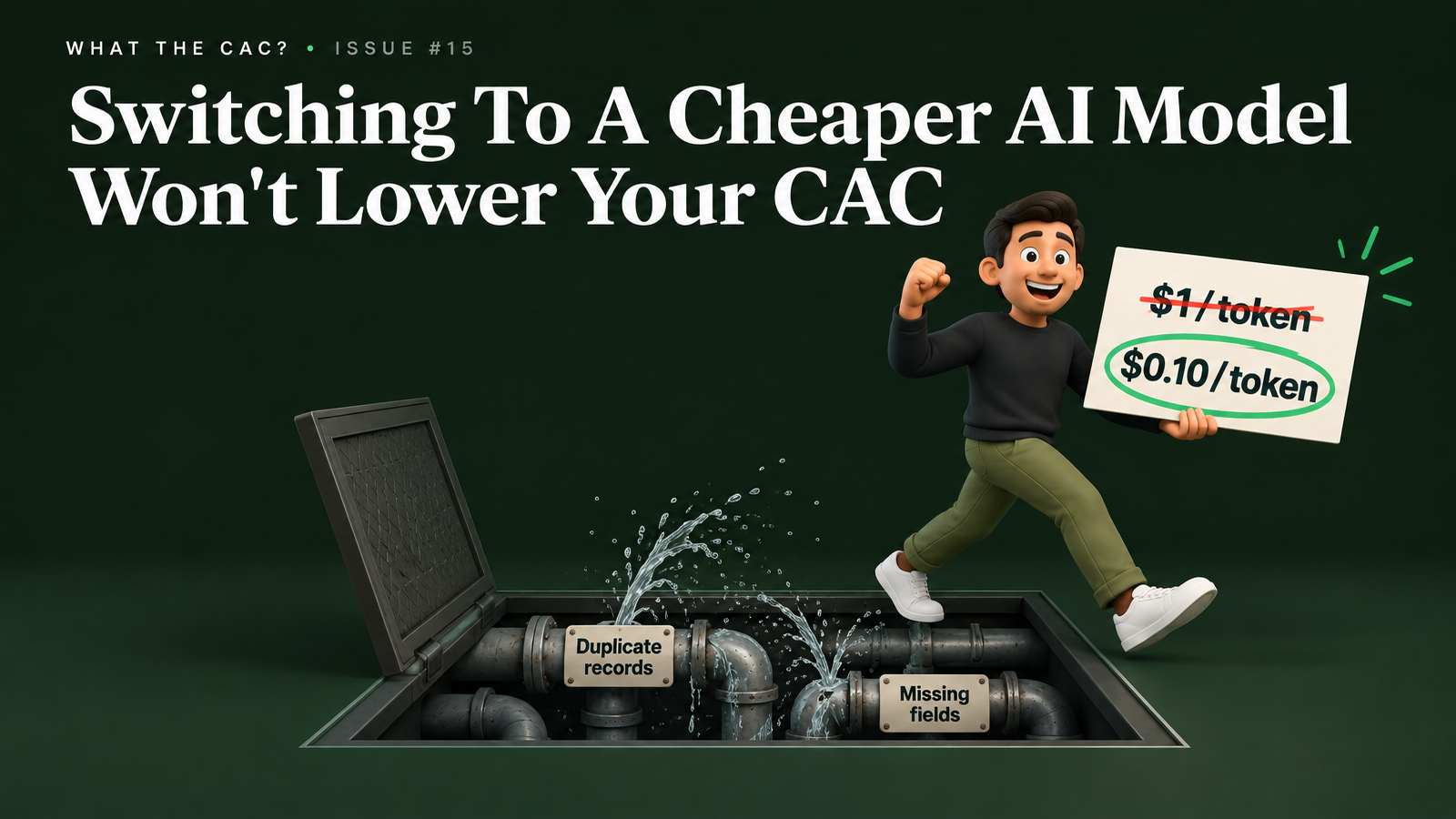
This week's focus is on what AI really costs after you buy it, and why messy data multiplies that cost.
I'll cover why AI works too well on bad inputs, why a cheaper model doesn't fix the bill on its own, what owning AI actually includes once the invoice is paid, and what to benchmark before your next renewal.
I build AI tools for clients, so it may surprise you that the advice I give most often is to hold off on buying one. I'm not against AI. I'm against paying for speed before the foundation can handle it.
Why does AI work too well on bad inputs?
AI does exactly what the data tells it, quickly and at scale. If the inputs are messy, it doesn't slow down or push back. It repeats the mess faster, and that is much harder to unwind than a slow manual process.
A person looking at a messy record usually notices that something is off. A model doesn't. Point it at fractured lead data and it scores half a record. Point it at an attribution report that credits the last touch and it pours budget into whatever your tracking happens to see. Point it at duplicate records and your best prospect gets the same email twice, or none at all because the system assumes someone else has the account.
Teams tend to judge readiness by what they bought. A better yardstick is whether the data and processes underneath can carry it, and three checks tell you quickly. How many accounts and contacts exist more than once, and which copy is the source of truth? Which fields are required when a lead moves from marketing to sales to customer success, and how often are they filled? And is there one agreed answer to where a deal came from, or one report per team?
“I build AI tools for clients, and my most common advice is still to fix the plumbing first.”
This reaches CAC quickly. A scoring model that scores half a record sends reps after the wrong leads, and every wasted rep hour is acquisition cost with nothing to show for it. When someone asks me which AI tool to buy, I usually suggest stepping back to the infrastructure first, because AI rewards clean inputs and punishes messy ones, and the punishment shows up as cost.
Related: stackfinder.com/answers/ai-readiness-diagnostic
Does a cheaper AI model lower what AI costs you?
Only the price per task. Your bill is that price multiplied by how many tasks you run, and messy data inflates the number of tasks. A model that is ten times cheaper still leaves you paying the same hidden tax if the same customer lives in your CRM four times.
Switching to a cheaper model is the right instinct. Models are becoming interchangeable, the best teams will follow output quality against cost, and nobody should pay more for the same answer. Being able to switch providers quickly is healthy.
The catch is that a bill is price times volume. Think about what AI does all day. It reads a record, enriches it, scores it, writes the follow-up, and summarizes the account for the rep. If one customer lives in your CRM four times, it does all of that four times and you pay for each copy. The copies also rarely agree. One has the old title, one has the right email, and one is tied to the wrong owner, so you are paying repeatedly for output built on records that never lined up.
For illustration, a tenfold price cut on a database that holds four copies of every customer still pays four times for each customer. Removing the extra copies cuts that bill by three quarters before the model changes at all. The two savings multiply, so a cheaper model and a cleaner database together do far more than either one alone. The same logic applies to data enrichment, where a lower cost per record still multiplies across a database with more records than it should have.
This belongs in a CAC conversation because what AI costs per processed record is part of the cost of running your go-to-market motion. Multiplied by duplicates, it raises CAC without appearing as a line anyone reviews.
Related: stackfinder.com/answers/ai-token-cost-management
What is a duplicate CRM record?
A duplicate CRM record is the same person or company stored more than once, usually with details that no longer match. Each copy gets processed separately, so duplicates multiply what AI costs and make its outputs disagree.
Duplicates come from forms, list imports, enrichment tools, and people who use different email addresses on different visits.
They cause problems because every copy is treated as a separate customer. The same buyer can get the same email twice, activity history is split across records, owners and lifecycle stages conflict, and lead counts are inflated. When AI is pointed at the data, each copy is processed separately, so duplicates multiply what AI costs and make its outputs disagree.
To fix them, choose a source of truth, define matching rules such as email, company domain, name, and phone number, and merge duplicates before enriching or running AI on the data. They affect CAC through wasted rep time, inflated lead counts, and AI usage spent on records that should not exist.
What does AI really cost after you buy it?
More than the price tag. Like a car, the sticker price is only the start. Maintenance, mileage, wear, connections, add-on charges, and the route you chose all add to the real cost of owning it.
Most people shop for a car by the sticker price and forget everything that comes after. AI works the same way, and the subscription is only the gas you can see each week.
Maintenance is the people and hours it takes to keep a tool working after launch, since data changes, instructions break, and someone has to own it. Mileage is what it costs to run AI all day, which climbs with every person and task you add. Wear and tear is the processes that quietly drift because nobody wrote down how the old way worked. Tires are the connections between your tools, which nobody notices until one goes flat. Toll roads are the add-ons and pay-per-use charges that show up after the contract is signed. And the route is your choice of build or buy and which problem or team goes first, because a bad route burns through everything else faster.
“Nobody budgets for the miles, the tires, or the tolls. They budget for the sticker price.”
Most of these costs are invisible at purchase. They land in headcount and in the budget lines that fund acquisition, which is how an AI project that looked cheap ends up raising CAC.
Related: stackfinder.com/answers/ai-total-cost-of-ownership
What should you benchmark before you roll out AI?
Pick one metric, agree on its baseline before launch, and decide how you will tell whether it moved. Without a before number, there is no way to show a return at renewal.
At Semrush I ran more than 250 A/B tests, and plenty of them lost. What made them worth running was that each one began with a baseline, a number we all agreed on before launch, and a way to tell whether it moved. AI should be rolled out the same way.
Many companies are heading into AI renewals without that. Leadership is asked whether the tool paid off and the honest answer is a feeling. Nobody benchmarked before rollout, so there is no before and after to point to. Some assumed they should build instead of buy without pricing what an action costs to build, run, and keep running. And in many places AI spend became a stand-in for productivity, with a bigger bill treated as progress even when nobody could show the work getting faster or cheaper.
Trial and error is fine, and it is how most teams will learn what AI can and can't do. But trial and error without a baseline means paying for the lessons and not keeping them.
For CAC, the benchmark is concrete. Before you add AI to a stage of your funnel, record what that stage costs and produces today, such as cost per qualified lead or cost per booked meeting, then compare after launch.
Related: stackfinder.com/answers/time-to-value
What should you do this week?
Three checks, each under an hour.
- Count how many times your five biggest customers appear in the CRM, and note which copy has the right owner and email.
- Write down what one AI tool costs to run for a month, including the people who maintain it, and what that stage of the funnel produced before you added it.
- Pick one AI renewal coming up and write down the baseline number you would use to show whether it paid off.
All three test whether you know what you are actually paying for.
If you want a second set of eyes on where your CAC is leaking, or what your software stack really costs you, you can book a call at stackfinder.com/deep-dive.
Reply and tell me what you found.
Share this issue