The CAC Problem Hiding in Customer Success
Why churn keeps inflating CAC and dragging down your LTV:CAC ratio, why acquisition takes the blame, and how to review the two together.
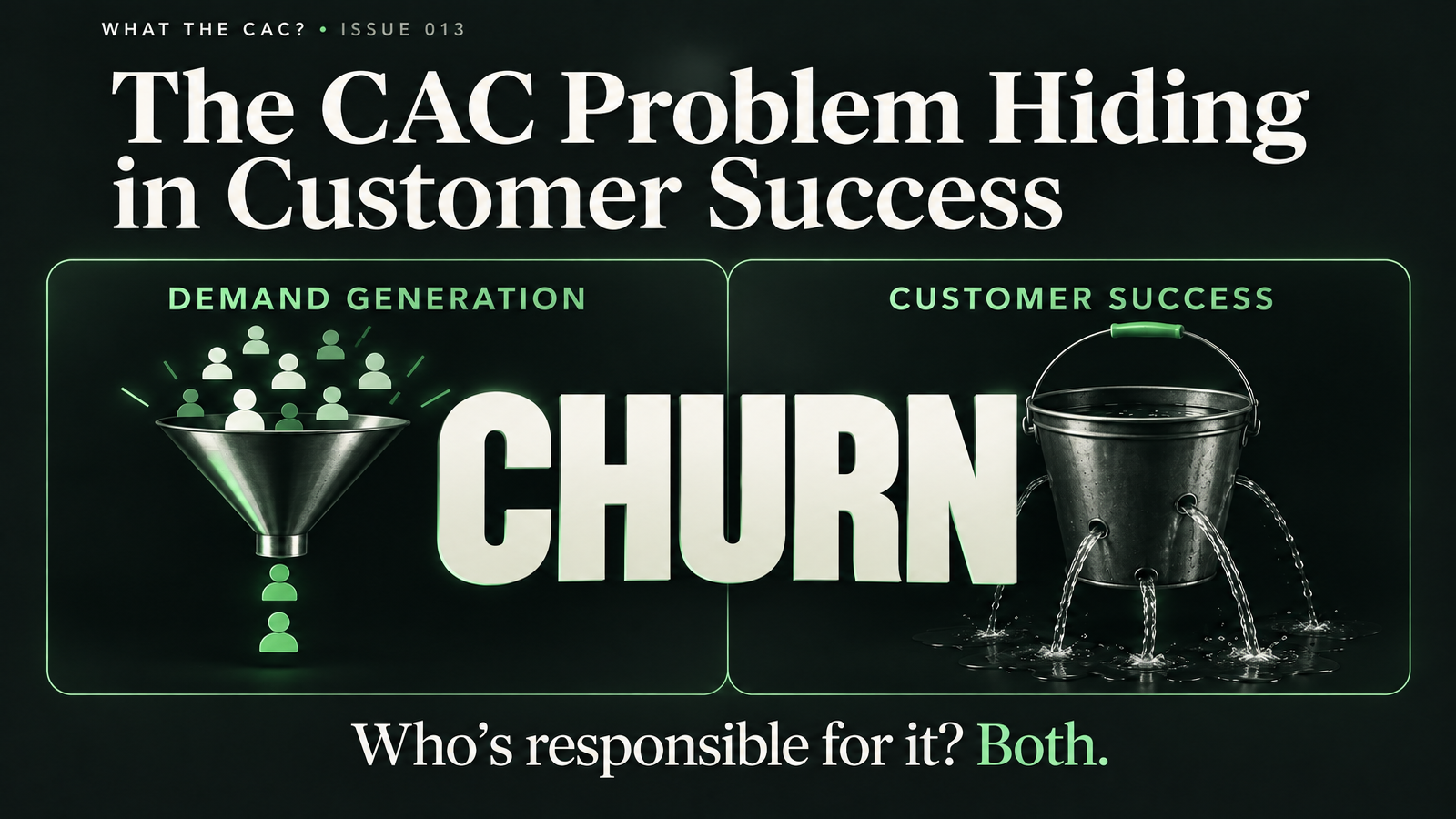
This week's focus is on how churn keeps inflating your CAC and pulling down your LTV:CAC ratio, and why the blame for it usually lands on the wrong team.
I'll cover why a strong lead acquisition engine can't outrun customers who leave, what a healthy LTV:CAC ratio looks like, how to tell whether the cause is who you sold to or what happened after the sale, and what gets lost when a deal moves to Customer Success.
I care about this one because the blame so often lands on the people who are easiest to see. In my experience, that is almost always the lead acquisition side.
In this issue
- Can a strong acquisition engine fix a churn problem?
- What is a good LTV:CAC ratio?
- What is customer churn rate?
- How do you tell whether churn is a fit problem or a delivery problem?
- Why does context get lost when a deal closes?
- What is a closed-won handoff?
- Who should own CAC when churn is driving it?
- What should you do this week?
Can a strong acquisition engine fix a churn problem?
No. A strong lead engine can only replace customers who leave. If churn stays high, it keeps spending to refill a bucket that keeps draining, and CAC keeps climbing.
CAC is what you spend to win customers, divided by the customers you win. When a customer leaves early, the money that won them returns very little, and you have to win another one just to stay level.
This is where the LTV:CAC ratio comes in. Lifetime value depends on how long customers stay, and a simple way to estimate that lifetime is one divided by the churn rate. If 5% of customers leave each month, the average customer stays about twenty months. If 10% leave each month, they stay about ten. Your CAC didn't change, but your lifetime value was cut in half, and the ratio fell with it. Nothing is wrong with the marketing or the sales team. The customers just aren't staying long enough to pay back what they cost.
That isn't how it looks in the room, though. Acquisition metrics move first and sit on dashboards everyone reads, such as cost per lead and blended CAC. Churn shows up later, in a different team's report. So when CAC rises, the first meeting is usually about lead generation, with more budget, new channels, or different messaging on the table. In my experience, most teams point the finger at the lead acquisition engine before they look at Customer Success.
“The cost shows up in acquisition. In my experience, the cause is usually somewhere quieter.”
That response often makes things worse. More spend adds more customers who leave the same way, and Customer Success inherits poor-fit accounts and gets measured on retention it never had a chance to save.
Related: stackfinder.com/answers/cac-payback-period
What is a good LTV:CAC ratio?
Roughly 3:1 is the widely used benchmark for efficient growth. It means a customer's lifetime value is about three times what it cost to acquire them, and it works best as a floor, not a target to optimize toward.
The ratio divides customer lifetime value by customer acquisition cost, and it matters because neither number means much alone. Teams also read a ratio near 3:1 or better as a sign of product-market fit, since it shows customers stay long enough to repay what they cost and then some.
Churn is the lever that moves it fastest. When customers leave early, lifetime value falls and the ratio drops, even if acquisition is performing well. Below 1:1 you lose money on every customer, and retention is usually the quickest fix. Read the ratio next to payback period too, since a healthy ratio with slow payback can still starve a business of cash.
Related: stackfinder.com/answers/ltv-cac-ratio | stackfinder.com/answers/cac-payback-period
What is customer churn rate?
Customer churn rate is the share of customers who leave during a period, calculated as customers lost divided by customers at the start. Early churn usually points to a fit problem, and late churn to a value or service problem.
How do you tell whether churn is a fit problem or a delivery problem?
Look at when customers leave and who they were. Early exits and poor matches point to who you sold to. Later exits among good matches point to what happens after the sale.
I use roughly 60% as the point where I stop looking at retention tactics and start looking at fit. That is a rule of thumb, not a law. Above that level, most of the customers who left were probably never the right buyer.
Before you change acquisition spend or add a retention tool, take a batch of recent churned accounts and ask three questions. How many of them match the customer you say you serve? How soon after signing did they leave? And if you ask one of them how you compared with the alternatives they considered, can they tell you?
Early exits usually mean they bought something you never built for them. If they can't explain how you differ from your competitors, your positioning has blended in. If they match your ideal customer and left late, look at onboarding, support, and the handoff instead.
The ratio depends on customers staying, so I aim acquisition at the customers who are likely to still be here after their first year. Look at the ones who have stayed that long and note what they share, such as industry, size, the problem they came with, and how they found you. That profile is a better target than any lead list, because it describes the customers who actually carry your ratio above 3:1.
“Churn shows up in customer success, but in my experience it gets decided much earlier.”
Related: stackfinder.com/answers/icp-and-positioning
Why does context get lost when a deal closes?
The handoff from Sales to Customer Success is treated as a meeting when it is really data. Without a record of why the buyer chose you and what they were promised, Customer Success starts from a logo and a PDF.
Before signature, Sales learns why the buyer is switching, what they were promised, and what terms they agreed to. After the deal closes, Customer Success usually inherits an account name, a contract file, and a kickoff call where the customer explains everything again.
Customers feel that gap before any report shows it. They told one person their reasons and now tell another, promises made during the sale turn into surprises later, and agreed renewal terms can go unnoticed by the team that manages the renewal.
This is also how Customer Success ends up carrying churn it inherited. When the record of what was promised never arrives, an early departure looks like a retention failure even though the gap opened before signing.
“Customers feel a failed handoff long before a report ever shows it.”
Fixing it starts with deciding what travels with the account. That means who the customer is and where they came from, why they bought, what was promised, and the key commercial terms. Then pick one customer ID and map it across the CRM, billing, product, and support, so records can be matched. It needs reliable matching, not perfection.
You don't need new software to start. A one-page handoff form that Sales completes before kickoff and Customer Success reads before the first call closes most of the gap. On that first call, the customer shouldn't have to repeat anything they already told Sales.
Part of the revenue seams series: https://lnkd.in/gUg5GaTA
What is a closed-won handoff?
A closed-won handoff is the transfer of a customer's context from Sales to Customer Success when a deal signs, including why they bought, what they were promised, and the terms they agreed to.
It works when the record travels with the account, so onboarding starts where the sale ended.
Related: stackfinder.com/answers/closed-won-handoff
Who should own CAC when churn is driving it?
Acquisition and Customer Success together. Judge acquisition by the customers still active after their first year, not by deals signed, and review CAC next to churn.
CAC is usually reported by the teams that win customers, and churn by the teams that keep them. When the two live in separate meetings, nobody sees how one drives the other.
A simpler approach is to look at the same group of customers from both ends. Take everyone you acquired in a quarter a year ago, split them by whether they are still active after twelve months, and calculate CAC for the customers who stayed. That number will be higher than your blended CAC, and it is closer to what growth really costs you. Then compare it with the lifetime value of those same customers, because the LTV:CAC ratio is what tells you whether you have product-market fit, and it should be read next to payback period. For recent cohorts that haven't reached a year, watch early churn as the leading signal.
It also changes the conversation. If the customers who stayed came from one channel and the ones who left from another, the problem is a targeting decision Sales and Marketing can fix. If both groups look alike, the problem sits after the sale, and Customer Success needs support, not blame.
Putting acquisition and retention in the same review is the cheapest fix I know.
Related: stackfinder.com/answers/net-revenue-retention
What should you do this week?
Three checks, each under an hour.
- Take the customers you acquired about a year ago, split them by whether they are still active, and compare CAC with lifetime value for the ones who stayed.
- Pull a batch of recent churned accounts, sort them by how soon after signing they left, and count how many match the customer you say you serve.
- Read your last five closed-won handoffs and check whether someone in Customer Success could say what each customer was promised without asking Sales.
All three test whether the cost you are blaming on acquisition is actually decided after the sale.
Reply and tell me what you found.
Share this issue